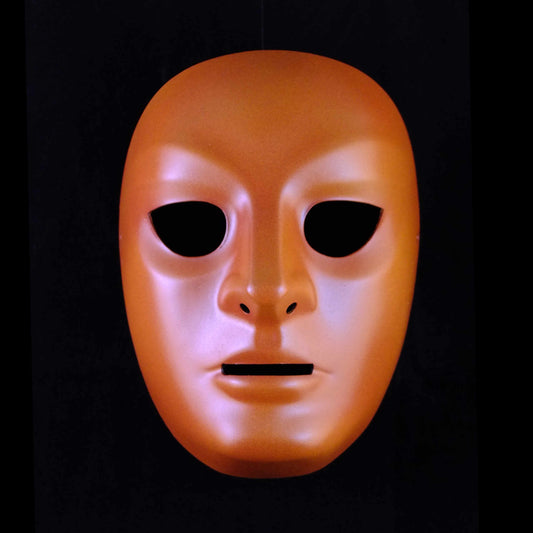
Neutral Masks
The neutral mask as foundation
For many teachers and practitioners, the neutral mask is a quiet but powerful ally. Developed by Jacques Lecoq at his École Internationale de Théâtre in Paris, it carries no personality, age, or emotion — representing a calm, universal human presence that removes individual expression to create what Lecoq called a "blank page" state. From this point of perfect balance and receptivity, actors discover economy of movement, spatial awareness, and genuine physical presence. For teachers and workshop leaders, this creates a clear, shared baseline, a place where everyone, regardless of experience, can begin together.
Neutral masks in drama training
Used in drama schools, conservatoires, and university theatre programmes worldwide, neutral mask work is a cornerstone of Lecoq-based pedagogy and physical theatre training. It develops the foundational skills that underpin all actor training: economy of movement, spatial awareness, receptivity to other performers, and the ability to inhabit a "zero state" from which any character can emerge. For drama teachers in secondary schools and sixth forms, neutral mask exercises offer a powerful and accessible introduction to physical performance. Exercises can be scaled for beginners or deepened for advanced performers, making it just as useful in a one-off session as in a long-term training programme.
Material, Construction and Delivery
- Made from high-impact thermoplastic.
- Hand-painted to a performance-standard finish.
- Lightweight, durable and comfortable to wear.
- Available individually or as a set of eight.
- Handmade to order in the UK.
- Shipped worldwide in 20 working days.
-
Regular price £75.00 GBPRegular price
Sale price £75.00 GBP -
Regular price £540.00 GBPRegular price
£600.00 GBPSale price £540.00 GBPSale
The Neutral Mask: Origins and Pedagogy
The neutral mask is one of the most significant contributions to physical theatre and actor training of the twentieth century. Its development is closely linked to the work of Jacques Lecoq, who placed it at the foundation of his pedagogical system at the École Internationale de Théâtre Jacques Lecoq in Paris. The principle is simple but profound: before a performer can fully embody character, they must first experience neutrality.
This “zero point” is not empty; it is alive with readiness. It is a state in which the performer is fully present, without anticipation or agenda. From a teaching perspective, it is invaluable, offering students a tangible experience of what it means to be on stage rather than to act.
Without this foundation, performers often build their work on habitual gestures or self-conscious choices. With it, they begin to develop a more responsive and truthful physical language.
It is no surprise that neutral mask work has had such a lasting influence, standing alongside the contributions of Konstantin Stanislavski and Bertolt Brecht as one of the defining ideas in modern theatre training.
What is the Neutral Mask? Presence, Balance, and the Zero Point
The neutral mask carries no character, no age, no emotion and no social identity. It is a face that offers nothing to interpret and everything to discover. When wearing it, the performer is invited to find what Lecoq called the état de disponibilité, a state of complete physical and perceptual readiness in which genuine presence becomes possible.
One of the reasons teachers value it so highly is its honesty. With the face hidden, there is nowhere to fake expression. What remains is the body in space and the quality of attention behind it. This makes it an exceptionally useful diagnostic tool in workshops and rehearsals, allowing facilitators to guide performers towards releasing habitual tension, becoming more aware of their physical choices and discovering movement that arises from genuine impulse rather than habit. Students may find this challenging at first, but also deeply rewarding. The mask does not judge; it simply reflects.
What it reveals with clarity is the quality of the performer’s presence in the moment. There is only the body in space, and the mask shows whether that body is genuinely present or simply performing presence. This makes it one of the most honest and revealing tools available to a drama tutor or director working in physical theatre or actor training.
The Neutral Mask in Practice: Training, Devising, and Performance
The neutral mask develops physical intelligence, perceptual sensitivity and genuine ensemble awareness at every level, from secondary school drama to professional performance.
In training, it often marks the beginning of a performer’s journey. It lays the groundwork for later work with expressive masks, character and text. In the Lecoq methodology, it precedes larval masks, Commedia dell’Arte masks and character full masks, establishing the physical and perceptual foundation from which all other mask work develops. It is equally valuable as a standalone tool. Outside a formal Lecoq context, drama tutors consistently report that even a short period of neutral mask work can transform the quality of a group’s physical communication and collective attention.
For workshop leaders and devising practitioners, it opens up a different kind of creative process. Rather than pushing for ideas, it creates the conditions for ideas to emerge, grounded in physical instinct and genuine curiosity. Many facilitators use it at the start of a project to help groups settle into the space, build trust and develop ensemble awareness, discovering what genuinely interests them physically. It does not generate character and narrative directly in the way that larval masks or Commedia masks might, but instead fosters something quieter and more fundamental: a shared physical attentiveness that makes everything that follows more alive.
In performance, the influence of neutral mask training is unmistakable, even when no mask is worn. It appears as stillness, clarity and a quiet authority on stage, the sense that a performer is fully present and available in the moment. When the neutral mask is used directly in performance, the effect on an audience can be striking, creating a quality of attention that is rarely achieved through other means.
These sections were written by Russell Dean, Artistic Director of Strangeface Theatre Company and founder of Strangeface Masks, with over twenty years of experience in mask making, performance and drama education.